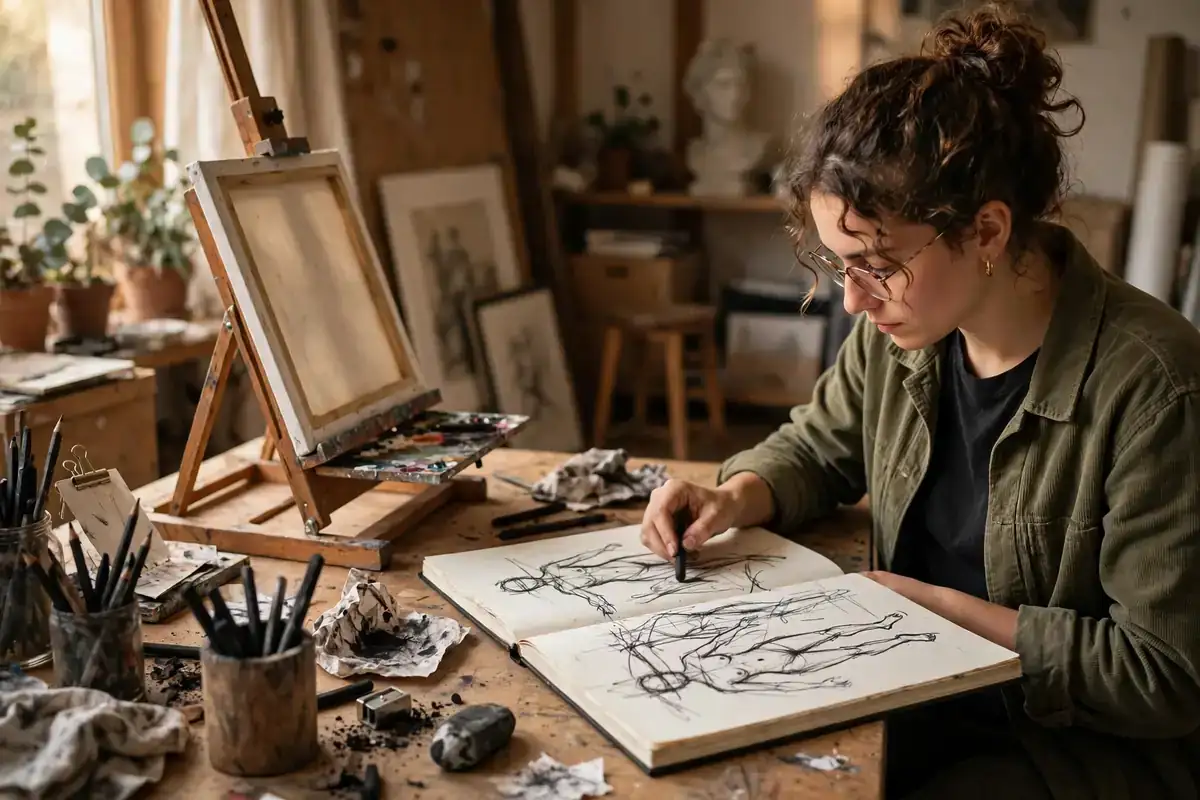
Gesture drawing is the fastest way to make your figure drawings feel alive. Instead of carefully outlining a body, you capture its movement, energy, and rhythm in thirty seconds to two minutes. The results look loose and scribbly, and that is exactly the point. Gesture drawing trains your eye to see the whole pose at once, before details distract you. Artists use it as a warm-up, as a study tool, and as the foundation for finished illustrations, comics, and animation.
If your figure drawings look stiff, like mannequins frozen in place, gesture practice will fix that faster than any anatomy book. Stiffness comes from drawing body parts one at a time without feeling how they connect. Gesture drawing forces you to feel the flow: the curve of a spine, the lean of a torso, the reach of an arm. This guide explains the line of action, timed practice, and the exercises that turn hesitant sketches into energetic ones.
What Is Gesture Drawing?
Gesture drawing captures the essence of a pose rather than its exact outline. You look for the main movement: is the figure stretching, crouching, twisting, or leaping? Then you draw that movement as one flowing line or a few sweeping curves. Details like fingers, facial features, and clothing come later, or not at all. A good gesture drawing can be just five lines, as long as those lines carry the feeling of the pose.
Think of it like summarizing a story in one sentence. You leave out the small facts and keep the meaning. A dancer mid-spin becomes a spiral. A runner becomes a diagonal surge. A seated person becomes a relaxed S-curve. Figure drawing for beginners builds on this skill, because every finished figure starts with a gesture that sets the pose. Without that foundation, even accurate anatomy looks lifeless.
Find the Line of Action
The line of action is a single imaginary curve that runs through the whole pose, usually from the head through the spine to the feet. It is the most important concept in gesture drawing. Before you draw anything else, find that line. Is it straight, curved, or S-shaped? Draw it first, boldly, across your page. Every other line in the drawing should support it, not fight it.
Practice by looking at photographs of athletes, dancers, or animals, and drawing only the line of action for each one. Do twenty in five minutes. You will quickly learn to see curves where you once saw only limbs. Drawing hands benefits from the same thinking, because a hand gesture has its own line of action running from wrist to fingertips. When the line of action feels right, the rest of the drawing falls into place more easily.
Use Timed Poses to Build Speed
Gesture drawing only works with a timer. Set a timer for sixty seconds, look at a pose, and draw until it rings. Then move to the next pose without judging the last one. Short times force you to prioritize the big movement over small details, which is the whole lesson. Start with two-minute poses for a week, then drop to one minute, then thirty seconds. Each shorter interval teaches you to see faster.
Free pose reference websites and apps offer timed photo sessions, or you can use a slideshow of sports photographs. Sketching practice in short bursts works the same way: frequent, low-pressure sessions beat rare, long ones. Draw at least ten gestures per session, and do not erase. Erasing breaks the flow and teaches you to fear mistakes. Gesture drawings are studies, not finished art, so let them stay messy.
Draw Big, Loose, and Fast
Beginners often draw gestures too small and too carefully. Use a full page for one pose, or at least half a page. Big drawings force your arm to move, and arm movement creates flowing lines. Hold your pencil loosely, work from the shoulder, and keep your lines continuous rather than sketchy. A single sweeping curve beats ten short, hesitant marks, even if the curve is slightly off.
Choose forgiving tools for gesture practice. Charcoal, soft graphite, or a brush pen all reward speed and flow. Charcoal drawing techniques suit gesture work especially well, because charcoal covers large areas fast and smudges into soft shadows. Pastel drawing offers similar speed with color, though it gets messy. Newsprint pads are ideal for practice, because cheap paper removes the pressure to make every page precious.
Exaggerate the Pose on Purpose
Good gesture drawings exaggerate slightly. Push the curve of a back a little further, stretch a reach a little longer, and lean a tilt a little more. Exaggeration makes the movement readable, and it counteracts the natural tendency to draw everything stiff and upright. Animators exaggerate constantly for this reason, and anime drawing relies on exaggerated poses to convey emotion. If your gesture looks too calm compared to the reference, push it further. You can always calm it down later in a finished drawing.
From Gesture to Structure
Once the line of action is down, add simple shapes for the head, ribcage, and pelvis. Think of the torso as two ovals connected by the spine curve, and the limbs as flowing tubes rather than detailed arms and legs. This step, called structuring, bridges the gap between a loose gesture and a believable figure. Keep it light and quick, and do not spend more than thirty seconds on it during a timed session.
Notice how weight affects structure. A standing figure shifts its hips over the supporting foot, while a running figure leans forward with arms pumping. Drawing faces follows a similar path from gesture to structure: a few guiding lines for tilt and direction come before any features. If a pose feels unbalanced, check whether the head, ribcage, and pelvis sit naturally along the line of action. One misplaced oval can throw off the whole figure.
Practice With Animals and Everyday Life
You do not need a life drawing class to practice gesture. Animals are excellent subjects, because they never hold still, which forces you to capture movement fast. Sketch dogs at a park, birds at a feeder, or cats stretching on a windowsill. Drawing cats teaches you to see feline curves, while drawing dogs shows how four-legged movement differs from human movement. Drawing horses is a classic gesture challenge, because a galloping horse compresses enormous energy into one flowing shape.
People in everyday life work just as well. Sketch commuters walking, children playing, or friends talking in a cafe. You have only seconds before the pose changes, so you learn to grab the essential movement immediately. Keep a small sketchbook with you for these moments. Five minutes of cafe sketching teaches more about natural poses than an hour of copying stiff photographs.
Common Gesture Mistakes
The most common mistake is drawing contours instead of gestures: carefully outlining the body as if it were a coloring book. Contour drawing has its place, but it kills movement. If you catch yourself outlining, stop, find the line of action again, and restart with a single curve. Another mistake is drawing every pose at the same size and centered on the page. Vary your composition: let a leaping figure run off the edge, or draw a crouching figure small and low.
Beginners also freeze when the timer feels short. Remember that a bad gesture in thirty seconds still teaches you something, while a blank page teaches nothing. Embrace the mess. Even professional animators produce pages of wild, scribbly gestures before they find the one pose that works. Your sketchbook is a laboratory, not a gallery, so fill it without fear.
Use Reference Photos Wisely
Photographs are useful, but they freeze movement in a way real life does not. Use photos to study poses you cannot see live, such as a gymnast mid-flip, but set the same timer you would for a live model. A photo that sits still for ten minutes invites you to outline details instead of capturing flow. Flip the photo upside down occasionally. The unfamiliar orientation forces you to see shapes and curves instead of named body parts, which keeps your gesture loose and honest. Combine photo practice with live sketching whenever possible, because real movement teaches timing that no photograph can.
Build a Daily Gesture Habit
Ten minutes a day will transform your figure drawing within a month. Start each session with five one-minute gestures, then five thirty-second gestures, then one two-minute gesture where you add simple structure. End by choosing your favorite gesture and redrawing it slowly, adding the anatomy you now understand. This routine links speed and accuracy, so your fast drawings inform your slow ones and vice versa.
Track your progress by dating your pages. After a few weeks, compare early gestures to recent ones. The newer ones will show longer, more confident lines and clearer lines of action, even if they still look rough. That confidence is the real goal of gesture drawing. Finished illustrations, comics, and character designs all start with the same skill you practice in these quick sessions: seeing movement, feeling flow, and putting it down before it escapes. Pick up your pencil, set a timer, and draw the next pose before it is gone.