Knowing how to sew is one of the most useful life skills you can learn, and it is also a deeply satisfying creative hobby. Sewing for beginners opens the door to hemming your own clothes, making simple gifts, creating home decor, and eventually designing garments that fit you perfectly. Across the United States, sewing is enjoying a strong revival, driven by interest in sustainable fashion, handmade goods, and the simple joy of making something with your own hands.
The best part is that sewing does not require talent or an expensive machine to start. A basic sewing machine, a few simple tools, and one easy project are enough to learn the fundamentals. In this guide, you will learn what sewing equipment you really need, how to thread and operate a machine, the essential stitches every beginner should know, and a step-by-step path from your first straight seam to your first finished project.
What Does Sewing for Beginners Actually Involve?
Sewing means joining fabric with thread, either by hand or with a machine. Hand sewing is slow but precise, and it is perfect for buttons, hems, and small repairs. Machine sewing is much faster and stronger, and it handles most everyday projects, from tote bags to curtains to simple dresses. Most beginners learn both: machine sewing for main seams and hand sewing for finishing touches that a machine cannot easily reach.
Before you sew a single seam, you need to understand a few basics about fabric. Fabric has a grain, the direction its threads run, and cutting along the grain keeps your projects from twisting or stretching out of shape. Cotton is the best fabric for beginners because it is stable, easy to cut, forgiving under the presser foot, and inexpensive. Avoid slippery fabrics like silk or stretchy knits for your first projects, since they shift and pucker under the needle. The patience you build here is similar to that needed for cross stitch for beginners, where careful counting and steady hands matter more than speed.
Sewing Supplies You Need to Start
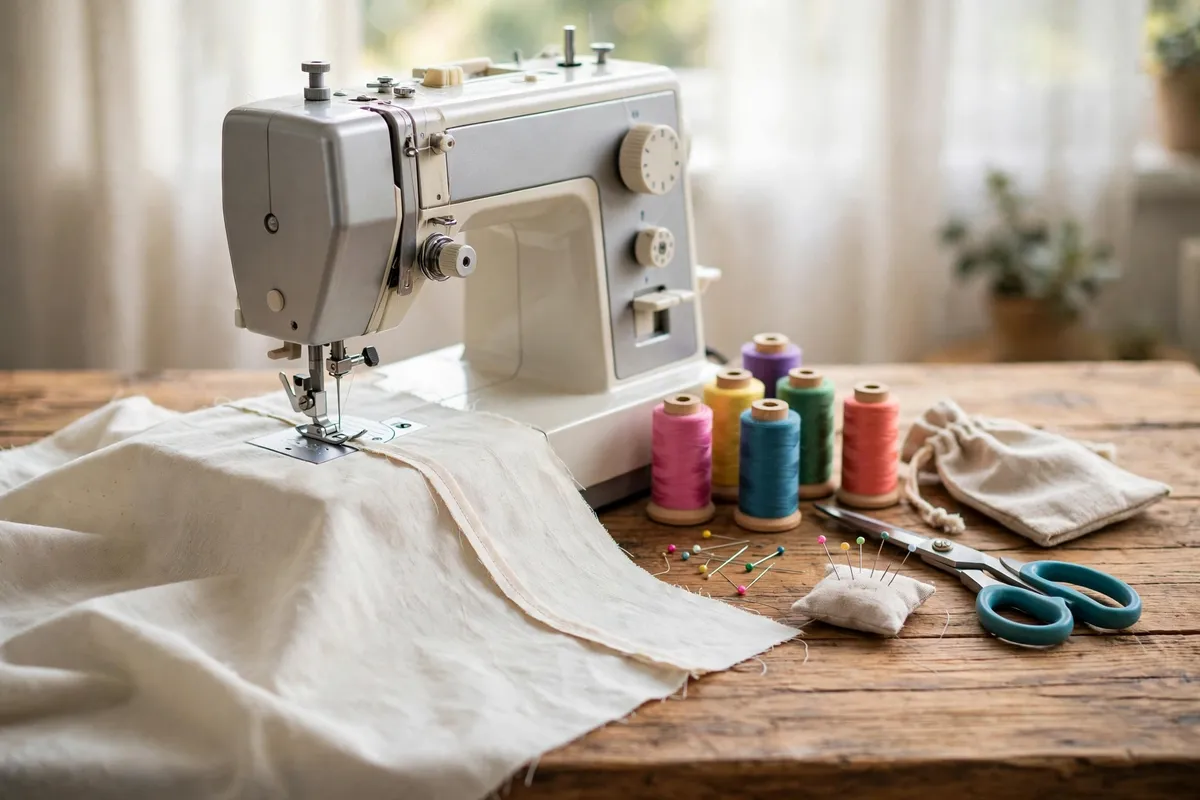
A beginner sewing kit is smaller than most people expect. You need a sewing machine, fabric scissors, pins and a pincushion, a seam ripper, measuring tape, tailor’s chalk or a fabric marker, an iron, and good-quality thread. Buy fabric scissors that you use only for fabric, because cutting paper dulls them quickly and makes cutting frustrating. A seam ripper will become your best friend, since every sewer, beginner or expert, rips out seams regularly.
Choosing Your First Sewing Machine
For a first machine, choose a simple mechanical model from a trusted brand rather than a complex computerized one. You need straight stitch, zigzag stitch, a buttonhole function, adjustable stitch length, and reverse stitching. That is enough for years of projects. Many American beginners buy refurbished machines from local sewing shops, which often include a lesson and a warranty, making them a better deal than a cheap new machine with no support. Test the machine before buying if you can, and make sure it feels smooth and quiet rather than rattly or stiff.
Thread, Needles, and Fabric Basics
Use all-purpose polyester thread for most projects, since it is strong and slightly flexible. Match your needle to your fabric: a universal needle works for cotton, while heavier fabrics need a denim needle and knits need a ballpoint needle. A dull or bent needle causes skipped stitches and puckering, so change your needle after every project or two. Pressing with an iron between steps is not optional, even though beginners often skip it. Pressed seams lie flat, look professional, and make the next step far easier, just as careful preparation matters in embroidery stitches for beginners.
How to Use a Sewing Machine Step by Step
Start by reading your machine manual and practicing on scrap cotton before touching a real project. Threading feels confusing the first time, but it becomes automatic after a few repetitions. Wind the bobbin, thread the top path exactly as the manual shows, draw up the bobbin thread, and test on a scrap piece. If your stitches look loopy or tangled, the machine is almost always threaded incorrectly, not broken, so rethread from the beginning before changing any settings.
Step 1: Sew a Straight Seam
Place two pieces of fabric right sides together, pin them along the edge, and sew with a standard seam allowance of five-eighths of an inch, using the guide on your needle plate. Sew slowly and steadily, guiding the fabric without pushing or pulling it, and let the machine’s feed dogs move the fabric for you. Backstitch at the start and end of every seam by pressing the reverse lever for a few stitches, which locks the thread so the seam cannot unravel. Practicing straight lines on scrap fabric for just twenty minutes builds more confidence than any tutorial video.
Step 2: Learn the Essential Stitches
Beyond the straight stitch, learn the zigzag stitch for finishing raw edges, the topstitch for crisp visible seams, and the basting stitch, a long temporary stitch for fitting and gathering. For hand sewing, learn the running stitch, backstitch, slip stitch for invisible hems, and whip stitch for closing openings. These few stitches cover nearly every beginner project, from pillowcases to tote bags to simple skirts. The same steady rhythm you develop here also helps with other fiber crafts like needle felting for beginners and macrame for beginners.
Step 3: Finish and Press Like a Professional
After sewing each seam, trim loose threads, press the seam open or to one side, and finish raw edges with a zigzag stitch or pinking shears so the fabric does not fray in the wash. Turn your project right side out, poke corners gently with a blunt tool, and press the whole piece one final time. This finishing stage is what makes a handmade item look store-bought rather than homemade, and it takes only a few extra minutes per project.
Easy First Sewing Projects for Beginners
The best first project is a simple tote bag, because it uses only straight seams and teaches cutting, pinning, sewing, pressing, and turning in one satisfying afternoon. Pillowcases are another excellent choice, since they are useful, quick, and forgiving. After those, try a drawstring bag, a simple apron, or curtains for a small window. Each project adds one new skill, so by your fifth project you will be comfortable with pockets, casings, and simple closures.
When choosing patterns, look for labels that say “easy” or “beginner” and avoid patterns with zippers, buttonholes, or set-in sleeves for now. Read the entire pattern before cutting anything, and always pre-wash your fabric, because cotton can shrink in the first wash and ruin a finished garment’s fit. American fabric stores offer many free beginner patterns, and local sewing classes, both in person and online, can help you through your first tricky step with a real teacher’s eyes on your work.
Common Sewing Mistakes Beginners Should Avoid
The most common mistake is sewing too fast. Speed causes crooked seams, broken needles, and skipped stitches, so slow down until control feels natural. Another mistake is skipping the iron, which makes seams bulky and projects look homemade. A third is using the wrong needle or thread, which causes constant thread breakage and frustration. Finally, many beginners skip test sewing on scrap fabric, then discover a tension problem halfway through a real project. A two-minute test on scrap fabric prevents almost every machine headache.
Measuring mistakes also cause trouble. Always measure twice and cut once, and remember that seam allowances are already included in most commercial patterns, so do not add them again. If a project goes wrong, the seam ripper is not a sign of failure, it is a normal tool that every experienced sewer uses often. The creative satisfaction of fixing a project yourself is part of why sewing pairs so well with other handmade hobbies like mixed media art for beginners and collage art for beginners.
Buying Fabric and Reading Patterns in the USA
Fabric shopping is much easier when you know what to look for. In American fabric stores, cotton quilting fabric is usually sold by the yard, folded on bolts, and labeled with its width, fiber content, and care instructions. For a first project, choose a medium-weight cotton in a print you love, and buy a little extra to allow for cutting mistakes. When you move to patterns, read the envelope carefully: it lists the recommended fabrics, the yardage for each size, and the notions you need, such as buttons or zippers. Buying everything on that list before you start prevents frustrating mid-project trips to the store. If a pattern term confuses you, look it up before cutting, since a five-minute explanation can save a ruined piece of fabric.
Conclusion: Your Sewing Journey Starts With One Seam
Sewing for beginners is a skill that pays for itself many times over. Start with cotton fabric, a simple machine, and a tote bag project. Learn to thread your machine, sew a straight seam, backstitch your ends, and press your work carefully. Each project will teach you something new, and before long you will be hemming clothes, making gifts, and sewing home decor with confidence. For more handmade inspiration, explore color theory for beginners, bedroom wall art ideas, sell art online, junk journal ideas, modern abstract art trends, and visiting an art exhibition to keep your creativity growing.