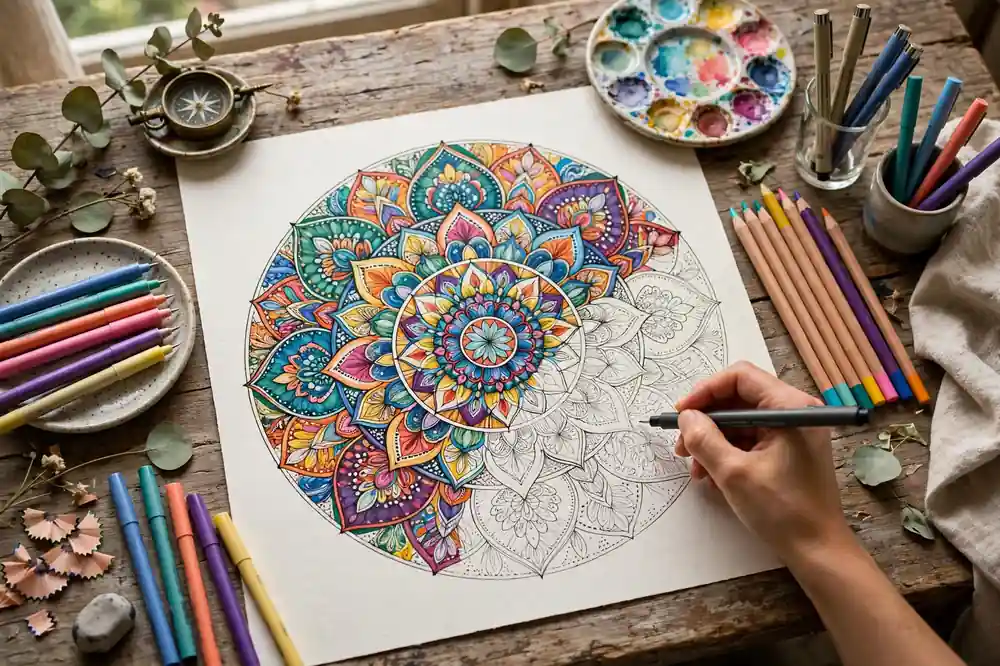
There is something deeply calming about drawing a mandala. You start with a single dot in the center of the page, then slowly build rings of petals, dots, and curves outward. Your breathing slows, your mind quiets, and a beautiful pattern grows under your hand. Mandala art for beginners is one of the easiest and most relaxing ways to start making art, and you do not need any drawing experience at all.
The word mandala comes from Sanskrit and means circle. For centuries, mandalas have been used in spiritual traditions, meditation, and art across Asia. Today, they are loved around the world as a creative practice that reduces stress, improves focus, and produces stunning artwork. In the United States, mandala coloring books, workshops, and online tutorials have made this ancient art form part of everyday creativity.
In this guide, you will learn what a mandala is, which tools you need, how to draw one step by step, and how to add color and your own creative twists. By the end, you will have a finished mandala to be proud of.
What Is Mandala Art for Beginners?
A mandala is a circular design built around a center point, with patterns that repeat outward in a balanced, symmetrical way. Think of a flower viewed from above, a stained-glass window, or ripples spreading across water. Each ring of the mandala echoes the ones before it, creating a sense of harmony and order.
For beginners, the beauty of mandala art is that there are no wrong answers. You choose the shapes, the patterns, and the colors. A simple mandala with a few repeated petals can look just as beautiful as a complex one. The process matters as much as the result, because the slow, repetitive drawing helps your mind relax. If you enjoy basic sketching for beginners, mandala art adds structure and calm to your practice.
Tools You Need for Mandala Art
One of the best things about mandala art is how little you need to start. Most beginners already have everything at home.
Pens and Paper
A fine black pen is the classic mandala tool. Pens with nib sizes between 0.3 mm and 0.8 mm give you crisp lines and fine detail. For larger outlines, a 1.0 mm pen or a brush pen adds bold contrast. Smooth, thick paper prevents ink from bleeding and lets you color without tearing. A guide to ink drawing techniques for beginners explains how different pens create different line qualities.
Drawing Aids
A compass, a ruler, and a protractor help you draw neat circles and evenly spaced sections. Many beginners also use a dotting tool or the end of a paintbrush to make perfect dots. A pencil is essential for planning your design lightly before you commit to ink. Do not worry if your circles are not perfect. Slight wobbles add handmade charm.
Color Supplies
Colored pencils, markers, or watercolor can all color a mandala beautifully. Colored pencil drawing is a gentle choice because it lets you layer and blend slowly. Markers give bold, even color, while watercolor creates soft, dreamy washes. Choose whatever you enjoy using, because enjoyment keeps you drawing.
Understanding Mandala Patterns and Symmetry
Symmetry is the secret behind a mandala’s beauty. When a pattern repeats evenly around the center, the eye finds it pleasing and restful. To create symmetry, divide your circle into equal sections, like slices of a pie. Common choices are eight, twelve, or sixteen sections. Then draw the same motif in each section, and the mandala will feel balanced automatically.
Popular mandala motifs include petals, teardrops, leaves, dots, arcs, and triangles. You can repeat one motif in every ring, or change the motif in each ring for variety. Understanding color theory for beginners will also help you pick color combinations that feel harmonious, such as blues and greens for calm, or warm oranges and pinks for energy.
Step-by-Step: Draw Your First Mandala
Find a quiet spot, put on some soft music if you like, and give yourself about an hour. There is no rush. Mandala drawing is meant to be slow and enjoyable.
Step 1: Draw the Base Circles
Mark the center of your paper with a small dot. Using a compass, draw several concentric circles around it, spaced evenly apart. These circles are your guides. They divide the mandala into rings, and each ring will hold a different pattern. Draw these guide circles lightly in pencil so you can erase them later.
Step 2: Divide Into Sections
Draw straight lines through the center to divide the circle into equal sections. A ruler helps here. Eight sections are a good starting point for beginners because they are easy to manage and look balanced. These lines are also guides, so keep them light.
Step 3: Draw the Center Motif
Start at the center with a simple shape: a small circle, a flower, or a star. This center is the heart of your mandala, so take your time. Draw slowly and breathe. Many artists find this step meditative, because it asks for focus on just one small shape at a time.
Step 4: Build Outward Ring by Ring
Move to the next ring and draw a repeated pattern, such as petals, in every section. Then move to the next ring and choose a new pattern, such as dots or arcs. Continue outward until you reach the edge of your circles. Work ring by ring, and do not try to finish everything at once. When your pencil design is complete, trace over it carefully with a fine pen. Let the ink dry, then erase the pencil guides. Your mandala will suddenly look clean and professional.
Adding Color to Your Mandala
Color transforms a black-and-white mandala into a vivid artwork. There are many approaches, and none is wrong. You can color each ring in a single color for a bold, graphic look. You can also use a gradient, moving from light colors at the center to darker colors at the edge, which creates depth.
Another popular approach is to color symmetrically: give every repeated motif the same color, so the symmetry of the drawing extends to the color. This takes patience but produces a stunning result. If you like soft color, try pastel drawing for beginners, where gentle pastel shades suit mandalas beautifully. Alternatively, gouache painting for beginners teaches opaque color techniques that make mandala patterns pop.
Mandala Art for Relaxation and Mindfulness
Many people turn to mandala art for stress relief, and research supports its calming effect. The repetitive patterns give your mind a gentle focus, similar to meditation. Worries fade into the background while you concentrate on the next petal or dot. As a result, many therapists and wellness teachers recommend mandala drawing as a mindfulness practice.
To get the most relaxation from your practice, draw without pressure. Do not aim for a perfect mandala. Instead, enjoy the rhythm of drawing. Set aside a regular time, such as twenty minutes in the evening, and treat it as a gift to yourself. Over weeks, you will notice that you feel calmer during drawing and that your patterns become more confident and creative.
Creative Mandala Ideas to Try
Once you can draw a basic mandala, the possibilities open up. Try a nature mandala, using leaves, flowers, and shells as motifs. Try a name mandala, where the center holds an initial letter surrounded by patterns. Or try a gratitude mandala, choosing colors that represent things you are thankful for.
You can also take mandala art beyond paper. Paint a mandala on a stone, a canvas, or a wooden board. Stitch a mandala pattern into fabric, inspired by embroidery stitches for beginners. Combine mandala drawing with journaling, using ideas from junk journal ideas to create pages that mix patterns, notes, and memories. For a three-dimensional twist, resin art for beginners shows how to preserve mandala designs in glossy, durable pieces.
Common Mistakes Beginners Make
The most common mistake is trying to make a mandala too complex too soon. A mandala with fifty rings and tiny details can feel overwhelming and frustrating. Start with four or five rings and simple patterns. As your confidence grows, add more rings and finer detail gradually.
Another mistake is pressing too hard with the pen, which makes lines look harsh and mistakes hard to fix. Use a light touch and accept small wobbles. A third mistake is skipping the pencil planning stage. Drawing directly in ink feels brave, but planning first saves you from lopsided designs. Finally, do not compare your mandala to professional artists online. Their work comes from years of practice, and your own style will develop with time.
Sharing Your Mandala Art
Mandalas make wonderful gifts. A hand-drawn mandala in a simple frame is a personal, meaningful present for birthdays, weddings, and holidays. You can also turn your designs into greeting cards, phone wallpapers, or coloring pages for friends. Many artists sell mandala prints and products online, and combining mandala art with other media opens even more possibilities. For inspiration on mixing materials, explore mixed media art for beginners.
Conclusion: Begin Your Mandala Practice Today
Mandala art for beginners is a beautiful blend of creativity, calm, and patience. With a pen, paper, and a little time, you can create patterns that are both relaxing to draw and stunning to look at. Start simple, work ring by ring, and let your own style emerge.
Tonight, draw a small mandala with just four rings. Color it in shades that make you happy. Notice how you feel while you draw, and how proud you feel when you finish. Then draw another one tomorrow. Before long, mandala art will become a favorite part of your day.