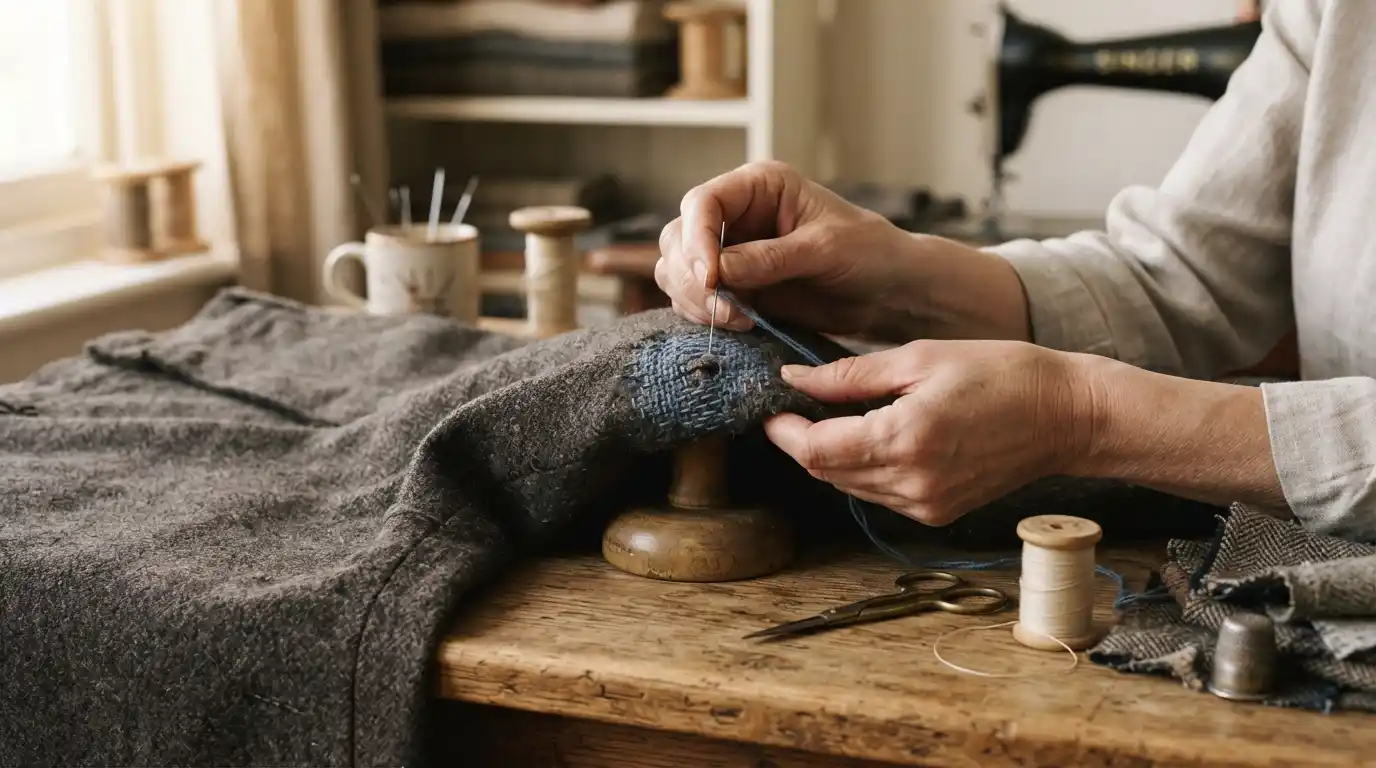
What makes darning especially interesting today is that it sits at the intersection of practical repair, traditional craftsmanship, personal style, and thoughtful clothing care. A repair can be almost invisible when matching thread is used, or it can become a deliberate decorative detail that gives a garment a distinctive character.
This renewed interest also fits naturally with the broader appreciation for timeless clothing and craftsmanship. From equestrian-inspired fashion to discussions of historic women’s fashion, style often becomes more meaningful when attention is given to construction, materials, and the story behind a garment.
What Is Old-Fashioned Darning?
Darning is a traditional textile-repair technique used to fill holes or reinforce worn sections of fabric with thread. Rather than simply placing a patch over damaged material, the repairer works thread through the weakened area, rebuilding enough of the textile structure to make the garment usable again.
The technique is particularly useful for small holes and areas of wear in garments such as socks, sweaters, shirts, trousers, and other woven or knitted items. The finished repair can be subtle or intentionally visible depending on the thread, stitch arrangement, and desired appearance.
That flexibility makes darning more than a purely functional skill. It can become part of a garment’s visual identity, much like carefully selected details in modern outfit styling can change the overall character of an ensemble.
Why Darning Was Once an Essential Household Skill
Before inexpensive mass-produced clothing became widely available, garments represented a much larger investment of time, material, and labor. Repairing clothing was therefore a normal part of household life.
A damaged sock did not necessarily mean a new pair. A worn sweater could be repaired. A thinning section of fabric could be strengthened before the damage became worse. Skills such as darning allowed people to preserve useful garments for considerably longer.
Historical textile collections contain examples of carefully executed repairs and darning samplers, showing how seriously needlework skills were once treated. The appeal was often practical: a good repair could preserve a valued item without drawing attention to the damaged area.
This philosophy is very different from a culture in which clothing can be replaced after relatively minor damage. It also provides an interesting contrast with the disposable side of contemporary fashion, where trends can change rapidly. Articles exploring old-fashioned darning therefore belong naturally within the wider conversation about clothing, craft, and lasting style.
From Invisible Repair to Visible Craft
Traditional darning often aimed to make a repair difficult to notice. The closer the thread matched the original fabric, the more discreet the finished work could appear.
Modern makers, however, have increasingly embraced the opposite approach. Contrasting threads can turn a repaired area into an intentional design feature. Instead of hiding the history of a garment, visible mending allows the repair to become part of its appearance.
This change reflects a broader movement toward individuality in clothing. Just as prom-dress styling can use details to create a memorable look, a carefully planned repair can give an everyday garment a unique visual character.
The result does not have to look rustic or unfinished. With consistent stitches, thoughtful thread selection, and attention to the surrounding fabric, a visible darn can look deliberate and sophisticated.
Why Old-Fashioned Darning Fits Modern Fashion
The renewed interest in traditional repair techniques is closely connected to changing attitudes toward clothing. Many people are becoming more interested in buying fewer pieces, caring for what they already own, and developing a wardrobe with a stronger sense of personal identity.
Darning supports that approach because it changes the relationship between the wearer and the garment. A sweater with a repaired elbow or a pair of trousers with carefully stitched wear marks can become more personal over time.
This idea connects with the enduring appeal of fashion-focused personal style. Style does not always require buying something new. Sometimes it comes from understanding how to care for, modify, and continue wearing something that already works.
It can also complement different aesthetics. Someone interested in historical clothing might appreciate subtle repairs, while someone drawn to contemporary streetwear could deliberately use bright thread and geometric stitching.
Choosing the Right Garment for Darning
Not every damaged garment needs the same type of repair. The first step is to examine the fabric and determine whether the surrounding material is still strong enough to support stitching.
Small holes in woven fabrics are often good candidates for darning. Knitted garments require a slightly different approach because the structure of the material is different. A repair should also take into account how much movement and friction the area receives.
For example, a decorative repair on the outer elbow of a jacket can be treated differently from a repair on the heel of a frequently worn sock. The goal is always to restore strength without creating unnecessary bulk or additional stress around the damaged area.
Basic Tools for Traditional Darning
One of the appealing aspects of hand darning is that the basic equipment is simple. A needle, suitable thread, scissors, and a way to support the fabric are usually enough to begin.
A darning egg or mushroom can make certain repairs easier by supporting the fabric from underneath. For delicate textiles, selecting a needle appropriate to the fabric is important because an overly large needle can create additional holes.
Thread selection is equally important. Matching thread creates a discreet repair, while contrasting colors can turn the repair into a decorative feature. Those choices can be treated as part of the garment’s overall styling rather than as an afterthought.
How to Darn a Small Hole
- Inspect the damaged area: Check the hole and surrounding fabric to determine how far the weakness extends.
- Support the fabric: Place the damaged section over a suitable darning surface so it remains stable while you work.
- Choose the thread: Match the original color for a subtle repair or select a contrasting shade for visible mending.
- Create the foundation: Work parallel stitches across the damaged area while extending slightly into the stronger fabric around it.
- Weave across the first direction: Add stitches in the opposite direction so the threads begin to recreate a stable textile structure.
- Keep tension controlled: Avoid pulling the thread too tightly because excessive tension can pucker the surrounding fabric.
- Finish carefully: Secure the thread without creating a bulky knot that could become uncomfortable during wear.
The exact technique varies according to the textile. Fine wool, heavy cotton, knitted garments, and delicate fabrics each require slightly different handling. Practice on an unwanted garment or fabric sample before attempting a particularly valuable piece.
Making a Repair Look Intentionally Stylish
Visible darning works best when the decorative decision feels connected to the garment. Instead of adding random colors, consider the existing palette, texture, and shape of the clothing.
A muted sweater might benefit from a simple contrasting stitch. Denim can work with heavier thread and geometric patterns. A colorful garment can use several related shades without overwhelming the original design.
The same principle applies to broader clothing choices. A well-planned repair can become another styling detail alongside the elements discussed in clothing and personal style.
Darning and the Return of Craftsmanship
Interest in old-fashioned darning is part of a wider appreciation for handmade work. Sewing, embroidery, weaving, knitting, and textile repair all require patience and physical interaction with materials.
That slower process can be appealing in an era dominated by rapid production. A repaired garment carries evidence of time and attention. Instead of looking identical to thousands of other pieces, it develops its own history.
The idea of craftsmanship also connects with the enduring fascination surrounding fashion from earlier eras, when construction details and garment longevity were important parts of clothing culture.
How Darning Supports a More Thoughtful Wardrobe
A thoughtful wardrobe does not necessarily mean owning expensive clothing. It can simply mean understanding which garments are useful, which pieces have sentimental value, and which items are worth maintaining.
Repair makes that approach practical. Instead of automatically replacing a favorite sweater because of one damaged section, the wearer has another option.
This philosophy can also make clothing more personal. A repaired garment may remind its owner of a particular period, project, trip, or person. The repair itself becomes part of the item’s story.
That sense of individuality is closely related to the appeal of distinctive fashion styles, where material, texture, and carefully selected details help create a recognizable look.
Old Techniques, New Styling Possibilities
Traditional repair does not have to remain locked in the past. Modern makers can experiment with colors, patterns, fabric combinations, and placement while respecting the underlying principles of textile repair.
A simple darn can be almost invisible. A series of contrasting stitches can become graphic. A repaired pocket can receive a decorative border. A worn knee can be reinforced with a carefully planned pattern.
These possibilities demonstrate why old-fashioned darning has relevance beyond basic clothing maintenance. It provides a way to combine utility and personal expression.
For anyone interested in the relationship between clothing and visual identity, topics such as modern fashion design provide another perspective on how clothing can communicate creativity and individuality.
Darning as an Alternative to Disposable Fashion Habits
Repairing a garment does not solve every problem associated with clothing production, but it can change how an individual approaches damaged items. A small defect becomes something to assess rather than an automatic reason for disposal.
That mindset encourages people to notice fabric quality, construction, wear patterns, and the practical value of the clothes they already own.
It also creates an opportunity to learn a tangible skill. Once someone becomes comfortable with a needle and thread, small repairs can become less intimidating and more approachable.
Old-Fashioned Darning in Contemporary Personal Style
The most interesting part of darning may be the way it combines history with individual expression. The underlying technique is practical and old, but the way people choose to display a repair can be completely contemporary.
A carefully repaired garment can sit comfortably alongside modern outfits, vintage-inspired pieces, or experimental fashion. The repair does not necessarily need to disguise the garment’s age. Instead, it can acknowledge that clothing becomes more interesting when it has been lived in and cared for.
This is one reason timeless clothing continues to attract attention. Trends change, but craftsmanship, durability, and personal connection remain relevant. Even highly occasion-focused clothing, such as the pieces discussed in prom-fashion styling, ultimately depends on thoughtful construction and detail.
Preserving the Skill for the Next Generation
Traditional repair skills become valuable when they are practiced and shared. Teaching a child or beginner how to thread a needle, understand fabric structure, and repair a small hole can turn an everyday problem into a useful learning experience.
Even simple repairs teach patience, hand coordination, observation, and respect for materials. More importantly, they demonstrate that an object does not automatically lose its value when it becomes imperfect.
The same appreciation for practical clothing can be seen in discussions of children’s clothing and seasonal dressing, where durability and everyday practicality can matter as much as appearance.
Why Timeless Craftsmanship Still Matters
Old-fashioned darning is ultimately about more than fixing a hole. It represents a different way of thinking about clothing: use it, understand it, maintain it, and give it another chance before replacing it.
For some people, the appeal will be practical. For others, it will be the satisfaction of working with their hands. And for those interested in visible mending, the repair itself can become an attractive part of a garment’s character.
As interest in craftsmanship and individual style continues, traditional techniques such as darning offer an appealing bridge between past and present. They remind us that clothing can be functional, expressive, personal, and durable at the same time.
Final Thoughts
Old-fashioned darning brings together repair, craftsmanship, creativity, and personal style. What was once an ordinary household necessity can now be appreciated as a meaningful textile skill and a way to make clothing last longer.
Whether the goal is to quietly restore a favorite garment or deliberately highlight a repair with contrasting thread, darning gives worn clothing another chapter. In a fashion culture that often emphasizes what is new, there is something refreshing about discovering the beauty of taking care of what we already have.