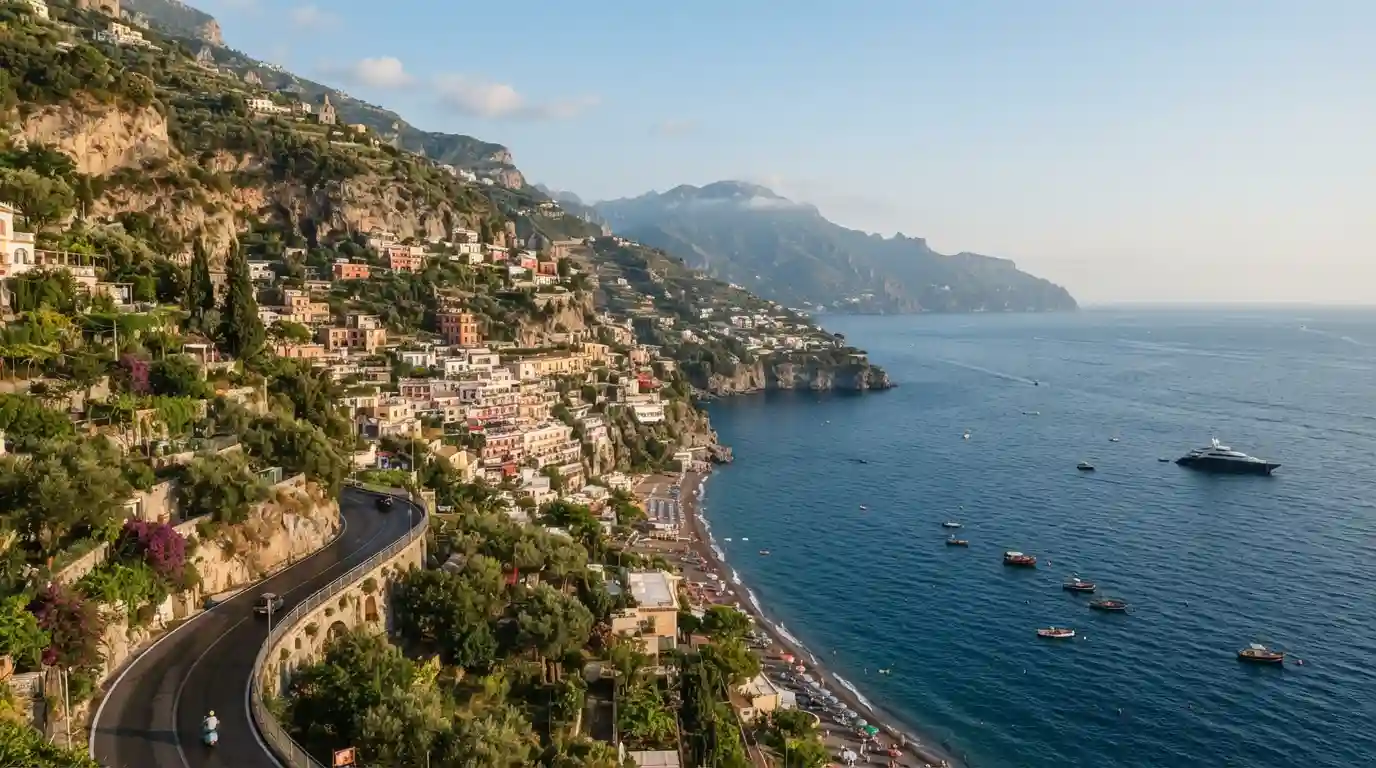
For travelers deciding where to go first, the best places to visit on the Amalfi Coast include famous destinations such as Positano, Amalfi, and Ravello, along with quieter towns such as Atrani, Cetara, Minori, and Vietri sul Mare. The region is also ideal for day trips, boat excursions, hiking, photography, and exploring nearby historic attractions.
Whether you are planning a romantic getaway, family vacation, summer road trip, or longer Italy itinerary, this guide highlights the top places to visit on the Amalfi Coast and what makes each destination worth adding to your trip.
1. Positano
Positano is often the first destination travelers picture when they think of the Amalfi Coast. Its pastel-colored buildings appear to cascade down the steep hillside toward the Mediterranean, creating one of Italy’s most recognizable coastal landscapes.
Spend time walking through the narrow streets, browsing boutiques, enjoying a meal with a sea view, or relaxing around Marina Grande. The town is also a popular starting point for boat excursions and coastal adventures.
Positano is particularly appealing for couples and photographers, but its steep streets and numerous stairways mean comfortable footwear is important.
2. Amalfi
The town that gives the coastline its name deserves a central place on any itinerary. Amalfi combines a historic center with a beautiful waterfront, making it one of the best places to experience both the cultural and coastal sides of the region.
The Cathedral of Sant’Andrea is one of the town’s most important landmarks. Visitors can also explore the pedestrian streets, small shops, cafés, restaurants, and waterfront areas before continuing along the coast.
Amalfi is also a convenient base for exploring nearby attractions and villages, making it especially useful for travelers who want to see several destinations without constantly changing hotels.
3. Ravello
High above the coastline, Ravello offers a completely different atmosphere from the busy waterfront towns. Its elevated position creates sweeping views across the Mediterranean and surrounding mountains.
Villa Cimbrone and Villa Rufolo are among the highlights. Their gardens, historic architecture, and viewpoints make Ravello one of the best stops for travelers interested in scenery, culture, and photography.
Ravello is also a strong choice if you want a quieter alternative to staying directly in Positano or Amalfi.
4. Atrani
Just a short distance from Amalfi, Atrani is a small coastal village with a more intimate atmosphere. Its compact historic center features narrow lanes, stairways, traditional buildings, and a central piazza close to the sea.
Because of its proximity to Amalfi, Atrani is easy to combine with a visit to the larger town. It is an excellent stop for travelers who want to experience a quieter side of the Amalfi Coast without traveling far from the major attractions.
5. Praiano
Praiano sits between Positano and Amalfi and is known for its dramatic hillside setting and beautiful coastal views. It can be a good choice for travelers who want access to the famous Amalfi Coast scenery while avoiding some of the intensity of Positano.
The town is especially appealing around sunset, when the western-facing coastline can provide beautiful evening views. Marina di Praia is another popular area for swimming, dining, and enjoying the sea.
6. Furore and the Fiordo di Furore
One of the most distinctive natural attractions along the coast is the Fiordo di Furore. The narrow inlet cuts into the steep cliffs, creating a dramatic landscape where the sea meets towering rock walls.
The small beach area below the cliffs is one of the most photographed locations on the Amalfi Coast. The surrounding scenery is particularly impressive when viewed from the coastal road or from the water.
Furore itself is more spread out than the classic coastal villages, so it is best approached as part of a wider sightseeing itinerary.
7. Conca dei Marini
Conca dei Marini is a small coastal community known for its cliffs, sea views, and connection to the famous Emerald Grotto. The area provides a quieter experience compared with the better-known towns farther west.
The Emerald Grotto, or Grotta dello Smeraldo, is a natural sea cave where changing light and water can create striking colors. Conditions and access can vary, so travelers should check local arrangements before planning a visit.
8. Maiori
If you want a destination with a more relaxed beach-town atmosphere, Maiori is worth considering. It has one of the more accessible stretches of beach along the Amalfi Coast and provides a useful base for exploring the eastern section of the region.
Maiori is also associated with the Sentiero dei Limoni, a scenic walking route through the lemon-growing landscape between Maiori and nearby Minori.
Travelers interested in combining sightseeing with longer walks may find Maiori more practical than some of the steeper villages.
9. Minori
Minori is a compact seaside town known for its beach, food traditions, and historic sites. It is located close to Maiori and can easily be included in a walking-focused itinerary.
One of the area’s notable attractions is the remains of a Roman villa, offering an interesting contrast to the modern coastal setting. The town is also connected with the Sentiero dei Limoni, making it a useful stop for travelers who want to explore the landscape on foot.
10. Vietri sul Mare
At the eastern end of the Amalfi Coast, Vietri sul Mare is particularly famous for its colorful ceramics. The town offers a different cultural experience from Positano and Amalfi, with decorative tiles and ceramic traditions visible throughout the historic area.
Vietri can be a convenient first or final stop when approaching the Amalfi Coast from Salerno. Its coastal position also makes it attractive for travelers looking for beaches, local crafts, and a less glamorous but highly characterful atmosphere.
11. Cetara
Cetara is a small fishing village that provides an authentic coastal experience. Compared with the more heavily visited destinations, it has a quieter character and a strong connection to traditional fishing and seafood.
Food-focused travelers should consider adding Cetara to their itinerary, particularly if they want to experience local cuisine beyond the restaurants in the most famous tourist towns.
12. The Path of the Gods
The Path of the Gods is one of the most famous hiking experiences near the Amalfi Coast. The trail is known for elevated views over the Mediterranean, mountains, cliffs, and coastal villages.
It is particularly appealing to active travelers who want to experience the landscape away from the main roads. Conditions can be demanding in places, so hikers should plan around weather, daylight, footwear, water, and their own fitness level.
For travelers who enjoy scenic hiking, this experience can be one of the highlights of an Amalfi Coast vacation.
13. The Sentiero dei Limoni
The Sentiero dei Limoni, or Lemon Path, offers a different perspective on the region. Rather than focusing only on sea views, the route passes through the agricultural landscape associated with the area’s famous lemon cultivation.
The route connects the area around Maiori and Minori and provides opportunities to see terraces, gardens, traditional pathways, and coastal scenery along the way.
It is a good option for travelers who want a shorter and more cultural walking experience than a full mountain hike.
14. The Beaches of the Amalfi Coast
The Amalfi Coast is not primarily known for long stretches of sandy shoreline. Many beaches are relatively small and are surrounded by cliffs, rocks, and steep terrain.
Popular coastal swimming areas can be found around Positano, Amalfi, Maiori, Vietri sul Mare, and other villages. Some coves are easier to reach by boat or by descending long stairways.
If beach time is a major priority, compare individual towns carefully before booking accommodation. A hotel with a beautiful sea view does not necessarily mean that a large, easily accessible beach is nearby.
15. Nearby Pompeii for a Historic Day Trip
Travelers spending several days in the region can consider adding Pompeii to their Italy itinerary. The ancient Roman city provides a powerful historical contrast to the coastal scenery of the Amalfi Coast.
Pompeii is especially worthwhile for visitors interested in archaeology, Roman history, architecture, and ancient daily life. Because it requires a separate excursion from the coast, it is best planned as a dedicated half-day or full-day experience rather than squeezed between multiple coastal towns.
Best Places to Visit on the Amalfi Coast for Different Travelers
Best for First-Time Visitors
Positano and Amalfi are usually the strongest starting points for first-time visitors because they combine iconic scenery, historic attractions, restaurants, shops, beaches, and transportation connections.
Best for Couples
Positano and Ravello are particularly attractive for romantic trips. Sunset views, scenic terraces, elegant accommodations, gardens, and intimate restaurants create an appealing atmosphere for couples.
Best for Beaches
Maiori, Amalfi, Positano, and Vietri sul Mare are useful options for travelers who want easier access to coastal swimming areas. Remember that beaches on this coastline can be compact and crowded during peak summer.
Best for Hiking
The Path of the Gods is the standout option for serious scenic hiking, while the Sentiero dei Limoni provides a more moderate way to experience the agricultural landscape.
Best for a Quieter Experience
Atrani, Cetara, Minori, and parts of Ravello can provide a calmer atmosphere than the busiest areas of Positano and Amalfi.
How Many Days Do You Need on the Amalfi Coast?
A 3-day Amalfi Coast itinerary can cover the major highlights, but five or more days allow you to explore at a more comfortable pace.
With three days, consider focusing on Positano, Amalfi, Ravello, and one additional village. With five days, you can add hiking, beaches, smaller towns, and a day trip such as Pompeii.
Longer stays are especially useful if you want time for boat trips, swimming, local restaurants, and scenic walks instead of moving from attraction to attraction.
Best Time to Visit the Amalfi Coast
Late spring and early fall can provide a good balance between pleasant weather and the intense crowds of the peak summer season. Summer is popular for swimming and long daylight hours but can be busy, especially in famous towns.
Spring is attractive for travelers who prioritize walking and scenery, while early fall can combine warm coastal conditions with a somewhat calmer atmosphere.
Tips for Exploring the Amalfi Coast
- Allow extra travel time: Coastal roads are scenic but can be slow, particularly during busy periods.
- Wear comfortable shoes: Stairs and steep streets are common throughout the region.
- Book popular accommodations early: The most sought-after towns can become expensive and crowded during peak season.
- Use boats when practical: Traveling by water can provide excellent coastal views and reduce dependence on busy roads.
- Do not rush every village: Choose a few priority destinations rather than trying to see everything in one day.
- Carry water: Walking between viewpoints, beaches, and historic centers can involve significant elevation changes.
- Plan around the season: Transportation, restaurant availability, crowds, and beach conditions can vary throughout the year.
Where to Stay on the Amalfi Coast
Choosing where to stay depends heavily on the type of trip you want. Positano is ideal for travelers seeking iconic scenery and a lively upscale atmosphere. Amalfi offers a central location with easy access to many attractions, while Ravello is better suited to travelers who prefer elevated views and a quieter setting.
Maiori and Minori can appeal to visitors looking for a more relaxed coastal base, while Vietri sul Mare can work well for travelers approaching the region from Salerno.
Final Thoughts
The best places to visit on the Amalfi Coast are not limited to its most famous towns. Positano delivers iconic coastal scenery, Amalfi combines history and waterfront charm, Ravello offers spectacular elevated views, and smaller destinations such as Atrani, Cetara, Minori, and Vietri sul Mare reveal a quieter side of the region.
For outdoor enthusiasts, the Path of the Gods and Sentiero dei Limoni add memorable walking experiences, while nearby Pompeii provides an excellent historical extension to a southern Italy itinerary.
The key to enjoying the Amalfi Coast is to slow down. Rather than trying to visit every village in a single trip, choose the places that best match your interests and leave enough time to enjoy the scenery, food, beaches, historic sites, and character of the coastline.
For more destination inspiration, explore our guides to the top places to visit in Italy, top places to visit in Naples, and best places to visit in Lake Como. You can also compare this destination with other international travel ideas, including South Bali, less-crowded places in Europe, Croatia in summer, and Greece for young couples.
Additional travel inspiration is available through our guides to Albania, Switzerland in summer, Ireland in spring, Dublin, Germany, Italy with kids, Midwest summer destinations, USA summer destinations, and popular destinations around the world.