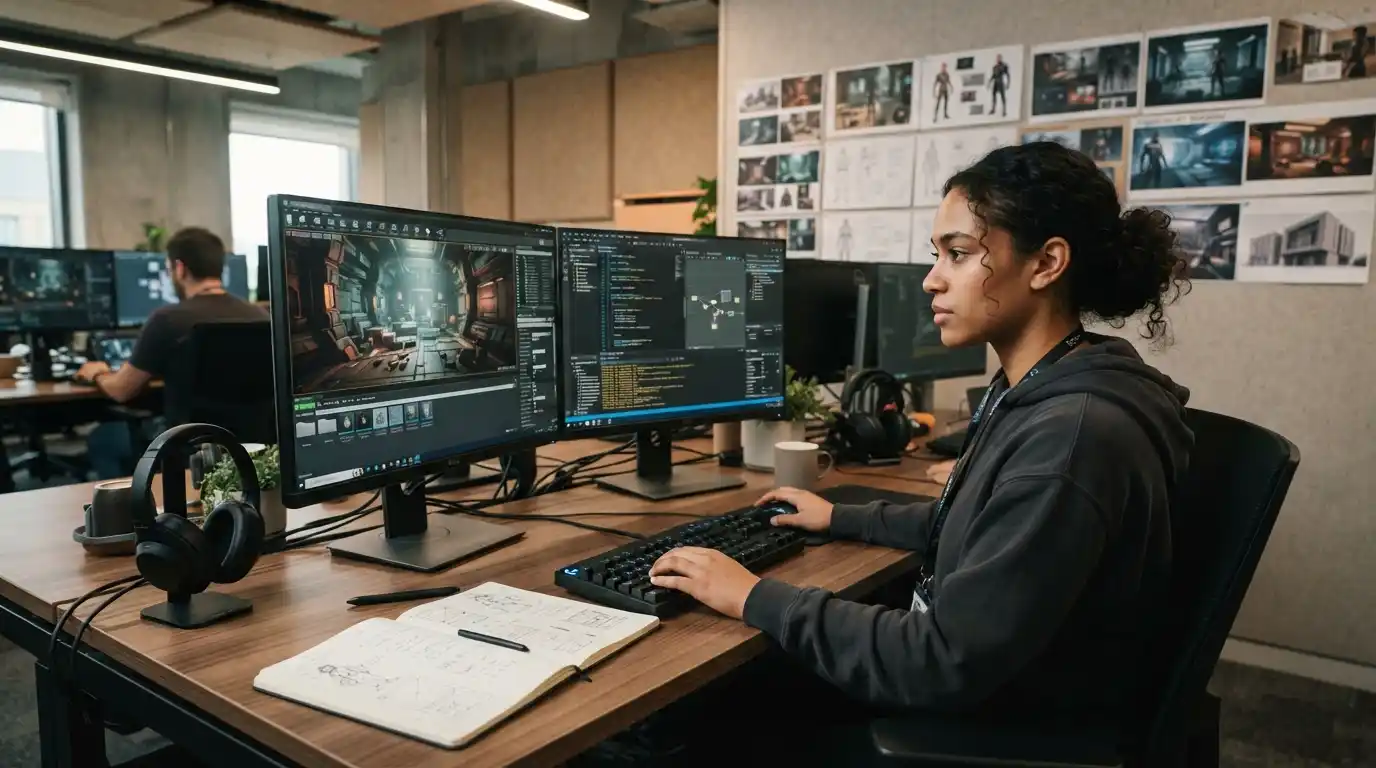
Breaking into the gaming industry takes more than simply enjoying games. Employers look for practical skills, curiosity, teamwork, communication, and evidence that you can contribute to a development environment. A well-prepared internship application can help you demonstrate those qualities while giving you a clearer understanding of the type of gaming career you want to pursue.
Why Consider a Gaming Internship?
A gaming internship can expose students to the professional side of game development. Instead of working only on classroom assignments or independent projects, interns may have opportunities to understand how different disciplines work together to create an interactive experience.
Game development is highly collaborative. Designers, engineers, artists, animators, writers, producers, testers, audio specialists, and other professionals must communicate throughout development. Learning how those disciplines interact can be just as valuable as improving a specific technical skill.
Students interested in the wider entertainment industry can also explore related subjects through resources such as entertainment and media topics, while those interested in creative careers may find broader inspiration from entertainment industry careers.
What Skills Can Help You Stand Out?
The exact skills needed depend on the internship. However, applicants can strengthen their profile by developing a combination of technical ability, creative thinking, and communication skills.
Programming and Technical Skills
Programming students can focus on languages, game engines, debugging, systems thinking, and software development practices. A small playable project can often communicate practical ability more effectively than a long list of technologies on a resume.
Students interested in technology careers can also broaden their knowledge by exploring technology career opportunities, technology and business innovation, and technology career development.
Game Design and Creative Thinking
Game designers need to think about mechanics, player interaction, progression, balance, and the overall experience. You do not necessarily need a huge game to demonstrate these abilities. A carefully designed prototype can show how you approach a problem and turn an idea into an interactive system.
Creative applicants can also learn from broader design and entertainment subjects, including media and entertainment development and creative entertainment concepts.
Art and Animation
Artists and animators can benefit from building a focused portfolio that demonstrates fundamentals as well as personal creativity. Character work, environment art, animation studies, concept pieces, UI work, and other relevant projects can help communicate your strengths.
Applicants exploring creative industries may also find useful inspiration from modern visual design trends and creative photography and visual art.
Build a Portfolio Before Applying
A portfolio gives an internship application something concrete to evaluate. Instead of simply saying that you are passionate about game development, you can show what you have built, designed, illustrated, tested, or analyzed.
Your portfolio does not have to contain a large commercial-quality game. A few carefully selected projects can be enough to demonstrate your interests and development process.
- Include projects that are relevant to the role.
- Explain your individual contribution to collaborative projects.
- Show development progress where appropriate.
- Describe challenges and how you solved them.
- Keep presentation simple and easy to navigate.
- Remove unfinished work that does not strengthen your application.
If your interests combine technology and creative work, studying topics such as digital technology and creative marketing can also help you understand how entertainment products are presented to audiences.
Education and Your Internship Preparation
Students should use their education to develop skills that directly support their intended career path. Coursework in computer science, game development, animation, art, design, business, communications, or related subjects can provide useful foundations.
Career-focused education can also extend beyond a traditional game-development curriculum. For example, education and career pathways can help students think about how academic choices connect with professional opportunities.
Those considering specialized career paths may also benefit from exploring career development and professional preparation and education and degree planning as examples of how different fields translate academic skills into careers.
How to Prepare Your Resume
An internship resume should make your relevant skills easy to identify. Students often have limited professional experience, so academic projects, personal game projects, competitions, volunteer work, and technical achievements can be important.
Keep the resume focused on the position. If you are applying for a technical role, highlight programming, development tools, prototypes, and relevant coursework. For an art position, emphasize portfolio work and creative software. For production or business-related roles, demonstrate organization, communication, project coordination, and analytical skills.
Career preparation is not limited to gaming. Looking at technology career opportunities and production and operational skills can help applicants understand the wider professional skills that companies value.
Prepare for the Interview
If your application progresses to an interview, be prepared to discuss your projects in detail. Interviewers may want to understand not only what you created but also why you made particular decisions.
Review your portfolio before the interview and be ready to explain:
- What problem your project was designed to solve.
- What your personal responsibilities were.
- Which tools and technologies you used.
- What went wrong during development.
- How you responded to feedback.
- What you would improve if you continued the project.
Strong communication matters because game development involves constant collaboration. Applicants can improve their professional awareness by exploring subjects such as leadership and strategic communication and business strategy and planning.
Look Beyond One Internship Opportunity
A career in gaming can develop through many different routes. If a particular internship is unavailable, continue building relevant skills and apply to other studios, technology companies, creative organizations, and entertainment businesses.
Experience in adjacent industries can also help. Skills learned through software development, digital media, animation, marketing, analytics, production, or other technology-focused roles can potentially become useful later in a gaming career.
For broader career research, resources covering digital strategy and business performance, digital careers in a changing economy, and growth-focused business skills can provide additional perspective on transferable professional abilities.
Final Thoughts
Respawn Entertainment internships can be an appealing target for students who want to explore professional game development, but preparation should begin well before an application is submitted. Build practical projects, develop role-specific skills, create a focused portfolio, improve your communication abilities, and learn how to explain your work clearly.
The most useful internship preparation is ultimately about demonstrating what you can contribute. Whether your interests are programming, design, art, animation, production, technology, or another area of gaming, consistent practice and a strong body of work can help you take the next step toward a career in the industry.